1. Introduction
Chinese Spelling Correction (CSC) is a critical NLP task with applications in search engines, OCR, and text processing. While BERT-based models have dominated the field, this paper reveals a fundamental flaw in their standard fine-tuning approach, leading to poor generalization on unseen error patterns.
2. Core Insight: The BERT Overfitting Paradox
The paper's central argument is provocative yet well-supported: standard fine-tuning of BERT for CSC causes it to overfit the error model (memorizing specific misspelling-correction pairs) while underfitting the language model (failing to learn robust contextual understanding). This imbalance cripples generalization.
2.1. The Dual-Model Framework
CSC is framed as a joint decision by two probabilistic models derived from Bayes' Rule:
$P(y_i|X) \propto \underbrace{P(y_i|x_{-i})}_{\text{language model}} \cdot \underbrace{P(x_i|y_i, x_{-i})}_{\text{error model}}$
Where $X$ is the input sentence, $y_i$ is the corrected character at position $i$, and $x_{-i}$ represents all other characters. The language model assesses what character fits the context, while the error model estimates the likelihood of a specific misspelling given the intended correct character.
2.2. The Generalization Problem
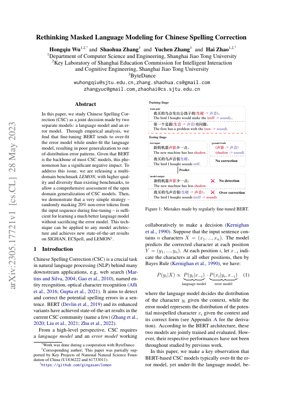
The error model, being simpler (often just character-level confusion), is easier for BERT to memorize during fine-tuning on limited datasets like SIGHAN. The language model, requiring deep semantic understanding, is harder to learn fully. The result is a model that acts like a lookup table for seen error pairs but falters with new ones or in novel contexts, as illustrated in Figure 1 of the paper with the "声影" (shadow) example.
3. Logical Flow: From Problem to Solution
The authors follow a clear diagnostic-prescriptive path: first, they expose the problem's root cause; second, they create a tool to measure it properly; third, they devise a simple, elegant fix.
3.1. Introducing the LEMON Benchmark
To move beyond the limited SIGHAN benchmarks, the authors release LEMON, a multi-domain CSC dataset with higher quality and diversity. This is a crucial contribution, as evaluating generalization requires a robust testbed. LEMON allows for a more realistic assessment of model performance in open-domain scenarios.
3.2. The Random Masking Strategy
The proposed solution is strikingly simple: during fine-tuning, randomly mask 20% of the non-error tokens in the input sequence. This forces the model to rely less on rote memorization of the input and more on reconstructing the context, thereby strengthening the language model component without degrading the error model. It's a form of data augmentation specifically tailored to the CSC task's dual nature.
4. Strengths & Flaws: A Critical Assessment
4.1. Key Strengths
- Conceptual Clarity: The dual-model Bayesian framework elegantly explains the inner workings of CSC.
- Practical Simplicity: The 20% random masking fix is low-cost, architecture-agnostic, and highly effective.
- Benchmark Contribution: LEMON addresses a real gap in the field's evaluation methodology.
- Strong Empirical Results: The method achieves SOTA on SIGHAN, ECSpell, and their new LEMON benchmark, proving its efficacy.
4.2. Potential Limitations
- Hyperparameter Sensitivity: The "20%" masking rate, while effective, may be dataset or model-dependent. The paper could have explored this sensitivity more.
- Scope of Errors: The approach primarily addresses phonetic/visual character confusion. Its effectiveness on grammatical or semantic errors (a harder CSC frontier) is less clear.
- Computational Overhead: While simple, the additional masking during training introduces slight overhead compared to vanilla fine-tuning.
5. Actionable Insights & Future Directions
For practitioners and researchers:
- Immediately adopt the random masking trick when fine-tuning any LM for CSC. It's a free performance boost.
- Evaluate models on LEMON in addition to traditional benchmarks to truly gauge generalization.
- Explore adaptive masking rates based on token uncertainty or error likelihood, moving beyond a fixed 20%.
- Investigate the framework for other languages with similar character-based writing systems (e.g., Japanese Kanji).
6. Technical Details
The core mathematical insight is the decomposition of the CSC probability. Given an input sequence $X = (x_1, ..., x_n)$ and target correction $Y = (y_1, ..., y_n)$, the model's decision at position $i$ is proportional to the product of two probabilities as shown in the formula in section 2.1. The random masking strategy intervenes during the fine-tuning objective. Instead of only predicting the original masked tokens (some of which are errors), it additionally forces predictions on randomly selected correct tokens, enhancing contextual learning. This can be seen as modifying the standard Masked Language Modeling (MLM) loss $L_{MLM}$ to include an extra term that encourages robustness for non-error contexts.
7. Experimental Results
The paper presents comprehensive results. On the SIGHAN 2015 test set, their method (applied to a BERT base model) outperforms previous approaches like SpellGCN and Realise. More importantly, on the newly introduced LEMON benchmark, the improvement is even more pronounced, demonstrating superior cross-domain generalization. The results quantitatively confirm that the model with random masking makes fewer over-correction errors (correcting right text to wrong) and misses fewer real errors compared to the baseline fine-tuned BERT. Figure 1 in the paper visually illustrates this with a case where the baseline fails to correct "声影" (shadow) to "声音" (sound) while incorrectly changing "生硬" (stiff) to "声音" (sound) in an inappropriate context.
8. Analysis Framework Example
Case Study: Diagnosing Model Failure
Input Sentence: "新的机器声影少一点。" (The new machine has less shadow.)
Ground Truth Correction: "新的机器声音少一点。" (The new machine has less sound.)
Error Pair: 声影 (shadow) → 声音 (sound).
Analysis using the Dual-Model Framework:
- Error Model Check: Has the model seen the confusion pair "声影→声音" during training? If not, the error model probability $P(\text{声影} | \text{声音}, context)$ may be very low.
- Language Model Check: Does the context "新的机器...少一点" strongly suggest "声音" (sound) as the appropriate word? A strong language model should assign a high probability $P(\text{声音} | context)$.
- Failure Mode: A baseline BERT model, having overfitted to seen error pairs (e.g., 生硬→声音, 生音→声音), may have a weak language model signal. Thus, the joint probability $P(\text{声音} | X)$ for the unseen pair remains too low for correction, leading to a "No detection" error.
- Solution: The random-masking-enhanced model has a stronger language model. Even with a weak error model signal for the unseen pair, the high language model probability can elevate the joint probability above the correction threshold.
9. Application Outlook
The implications extend beyond academic benchmarks:
- Enhanced Pinyin Input Methods: More robust CSC can significantly improve the accuracy of IMEs (Input Method Editors) that convert phonetic input (Pinyin) to characters, especially for ambiguous sounds.
- Educational Tools: Intelligent tutoring systems for Chinese language learners can provide better feedback on spelling mistakes by understanding context, not just common errors.
- Content Moderation & Search: Social media platforms and search engines can better handle user-generated content with typos, improving content retrieval and filtering.
- Low-Resource Dialects: The framework could be adapted to model common error patterns when writing regional dialects in standard Chinese characters.
- Cross-Modal Spelling Check: Integration with speech recognition or OCR pipelines, where the error model can be informed by acoustic or visual similarity, not just textual patterns.
10. References
- Devlin, J., Chang, M. W., Lee, K., & Toutanova, K. (2019). BERT: Pre-training of Deep Bidirectional Transformers for Language Understanding. NAACL-HLT.
- Wu, H., Zhang, S., Zhang, Y., & Zhao, H. (2023). Rethinking Masked Language Modeling for Chinese Spelling Correction. arXiv:2305.17721.
- Kernighan, M. D., Church, K. W., & Gale, W. A. (1990). A Spelling Correction Program Based on a Noisy Channel Model. COLING.
- Zhang, S., Huang, H., Liu, J., & Li, H. (2020). Spelling Error Correction with Soft-Masked BERT. ACL.
- Liu, S., Yang, T., Yue, T., & Zhang, F. (2021). PLOME: Pre-training with Misspelled Knowledge for Chinese Spelling Correction. ACL.
- Zhu, C., et al. (2022). FastCorrect 2: Fast Error Correction on Multiple Candidates for Automatic Speech Recognition. EMNLP.
- Goodfellow, I., et al. (2014). Generative Adversarial Nets. NeurIPS. (Cited for conceptual analogy of dual-model competition/balance).
- Google AI Blog - BERT. (n.d.). Retrieved from https://ai.googleblog.com/2018/11/open-sourcing-bert-state-of-art-pre.html