1. Introduction & Background
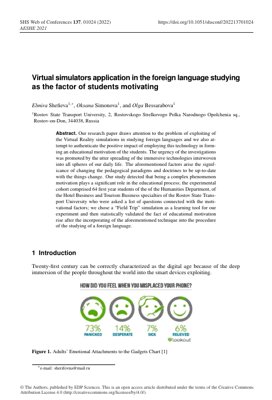
The 21st century is characterized by deep digital immersion, fundamentally altering daily life and, by extension, educational paradigms. This research paper addresses the urgent need to adapt classical pedagogical methods to this new reality, particularly in foreign language education. The study posits that student motivation is a critical, multi-faceted component of learning success, encompassing biological, cognitive, and behavioral aspects. Against a backdrop of widespread digital device attachment—as evidenced by charts showing significant emotional attachment to gadgets and high internet usage among youth—the authors argue for the integration of immersive technologies like Virtual Reality (VR) to enhance engagement and efficacy in language acquisition.
Key Statistic
300%
Growth in digital device consumption between 2011 and 2016.
2. Research Methodology
The study employed an experimental design to investigate the impact of a VR simulation on student motivation.
2.1. Participant Demographics
The experimental cohort consisted of 64 first-year students from the Humanities Department, specializing in Hotel Business and Tourism Business at Rostov State Transport University.
2.2. The "Field Trip" Simulation
A specific VR simulation titled "Field Trip" was selected as the primary learning intervention tool. This simulation was designed to create an immersive, context-rich environment for practicing foreign language skills in a simulated real-world scenario relevant to the students' fields of study (e.g., checking into a hotel, guiding tourists).
2.3. Data Collection & Analysis
Data was collected via questionnaires administered before and after the VR intervention. The questionnaires were designed to measure various motivational factors. Statistical methods were then applied to validate changes in motivation levels.
3. Experimental Results & Findings
3.1. Pre-Experiment Motivation Baseline
Initial questionnaire results established a baseline level of motivation among the participants, which was used for comparative analysis.
3.2. Post-Experiment Motivation Assessment
Following the VR "Field Trip" simulation, a subsequent questionnaire was administered. The data indicated a measurable positive shift in students' reported levels of engagement, interest, and perceived relevance of the foreign language material to their future careers.
3.3. Statistical Validation
The researchers performed statistical analysis on the pre- and post-test data. The study concludes that the results statistically validated a rise in educational motivation after incorporating the VR simulation into the foreign language learning procedure.
Key Insights
- VR provides contextually rich, immersive environments that bridge the gap between abstract language learning and practical application.
- Motivation in language learning is not monolithic; VR can positively impact specific facets like instrumental motivation (career utility) and intrinsic interest.
- The success of the "Field Trip" simulation suggests that alignment between VR content and learners' professional/academic goals is crucial.
4. Discussion & Analysis
An industry analyst's perspective on the research.
4.1. Core Insight
The paper's core insight is both powerful and painfully obvious: in an age of digital saturation, education must compete for cognitive engagement. The study correctly identifies that traditional, passive language instruction is losing the battle for the attention of Gen Z learners, whose neural pathways are wired for interactive, multimedia stimuli. The real value proposition of VR here isn't novelty; it's contextual fidelity. By placing hotel and tourism students in a virtual hotel or tourist site, the technology directly activates career-relevant schemas, making vocabulary and grammar feel less like academic hurdles and more like professional tools. This aligns with foundational theories in educational psychology, such as Situated Learning Theory (Lave & Wenger, 1991), which emphasizes learning within authentic activity contexts.
4.2. Logical Flow
The paper's logic is sound but follows a well-trodden path: identify a technological trend (VR adoption), hypothesize its educational benefit (increased motivation), test via a controlled experiment, and report positive results. The strength lies in its focus on a specific, underserved niche—vocational language learners—rather than making broad claims about all education. The chain from "digital immersion" to "pedagogical need" to "VR as a solution" is coherent. However, it implicitly assumes motivation is the primary barrier to language acquisition, potentially overlooking other critical factors like instructional quality, practice frequency, or foundational literacy skills in the native language.
4.3. Strengths & Flaws
Strengths: The study's applied focus on hospitality and tourism is a major strength, offering a clear use case. Using a pre/post-test design with a specific cohort provides actionable, if preliminary, data. Acknowledging motivation as a complex, multi-dimensional construct shows theoretical awareness.
Significant Flaws: The sample size (n=64) from a single university limits generalizability. The paper lacks granular detail on the VR simulation's technical specs, instructional design principles, or the specific statistical tests used—a critical omission for replication. Most glaringly, it measures motivation via self-report questionnaires, which are notoriously susceptible to the "novelty effect" or social desirability bias. Did motivation sustain over a semester, or was it a temporary spike? The study, as presented, cannot answer this. Compared to more rigorous VR studies in fields like medical simulation—which measure skill transfer and retention—this feels like a promising pilot rather than definitive proof.
4.4. Actionable Insights
For educators and institutions: Start small and context-specific. Don't buy VR headsets to "teach French"; buy them to "train French for hotel reception." The ROI is clearer. Partner with industry to design simulations that mirror real workplace tasks.
For researchers: The next step must be longitudinal. Track the cohort's language proficiency scores (e.g., standardized test results) over time alongside motivation metrics to establish a causal link between VR, motivation, and actual learning outcomes. Incorporate biometric data (eye-tracking, heart rate) from the VR session to move beyond self-reporting and gain objective engagement metrics.
For EdTech developers: This study is a market signal. There is demand for high-quality, profession-specific VR language content, not just generic "conversation simulators." The winning platform will be the one that best enables educators to customize scenarios without needing a game development team.
5. Technical Framework & Mathematical Modeling
While the PDF does not detail a mathematical model, the core hypothesis can be framed using a simplified linear relationship. We can model the change in motivation ($\Delta M$) as a function of the VR intervention's characteristics:
$\Delta M = \alpha \cdot I + \beta \cdot C + \epsilon$
Where:
- $\Delta M$: Change in motivation score (post-test minus pre-test).
- $I$: Immersion factor of the VR simulation (a quantified measure of presence, e.g., from a presence questionnaire).
- $C$: Contextual relevance of the simulation to the learner's goals (e.g., a score from 0 to 1).
- $\alpha, \beta$: Coefficients representing the weight of each factor, determined through regression analysis on experimental data.
- $\epsilon$: Error term accounting for other unmeasured variables (e.g., prior attitude towards technology).
The study's claim of statistical validation implies that a statistical test (likely a paired-sample t-test) was performed on the $\Delta M$ values, yielding a result where $p < 0.05$, rejecting the null hypothesis that the VR intervention caused no change.
6. Analysis Framework: A Non-Code Case Study
Scenario: A university wants to evaluate if a VR "Clinical Interaction" simulation improves motivation for medical students learning medical Spanish.
Framework Application:
- Define Metrics: Motivation is operationalized via a survey with sub-scales: Intrinsic Interest (II), Perceived Utility (PU), and Learning Anxiety (LA, inverse score).
- Baseline Measurement: Administer survey to Cohort A (control, uses textbook role-play) and Cohort B (experimental, uses VR) before the module.
- Intervention: Both cohorts complete the same learning objectives. Cohort B uses the VR simulation for practice.
- Post-Intervention Measurement: Re-administer the survey and a standardized medical Spanish proficiency assessment.
- Analysis: Calculate $\Delta$II, $\Delta$PU, $\Delta$LA for each cohort. Use statistical tests (ANCOVA) to compare the $\Delta$ scores between cohorts, controlling for pre-test scores. Correlate motivation $\Delta$ scores with proficiency assessment results.
- Interpretation: If Cohort B shows significantly greater positive $\Delta$ in II and PU, and a greater reduction in LA, and these changes moderately correlate with higher proficiency scores, the VR intervention is supported as a motivator that may contribute to learning.
7. Future Applications & Research Directions
- AI-Powered Adaptive VR: Integrating NLP AI (like GPT-based agents) into VR environments to create dynamic, responsive conversation partners that adjust difficulty and topics in real-time based on learner performance.
- Social VR Language Labs: Multi-user VR spaces where learners from across the globe can interact and collaborate on tasks in the target language, fostering not just motivation but also intercultural competence.
- Biometric Feedback Loops: Using VR headset sensors (eye-tracking, facial expression analysis) to detect moments of confusion or frustration and adapt the scenario or provide just-in-time scaffolding.
- Longitudinal & Transfer Studies: Research must track the durability of motivational effects and, crucially, measure the transfer of VR-acquired language skills to real-world, non-VR interactions.
- Cost-Benefit Analysis: As hardware costs decrease, research should focus on the scalable instructional design models for VR, comparing its efficacy and cost to other immersive but lower-tech methods (e.g., augmented reality on smartphones).
8. References
- Chart Source: Pantas and Ting Sutardja Center for Entrepreneurship & Technology, citing Konok, V., et al. (Referenced in PDF).
- Richter, F. (Statista). Data on American Teens' Internet Use (Referenced in PDF).
- Fandiño, F.G.E., et al. (Cited in PDF for motivation factors).
- Woon, et al. (Cited in PDF for motivation as a mixed process).
- Lave, J., & Wenger, E. (1991). Situated Learning: Legitimate Peripheral Participation. Cambridge University Press.
- Isola, P., Zhu, J., Zhou, T., & Efros, A. A. (2017). Image-to-Image Translation with Conditional Adversarial Networks. CVPR. (Example of a rigorous technical paper in a related field of generative models, which VR content creation often relies upon).
- Meta Platforms, Inc. (2023). Horizon Workrooms and related research on social presence in VR. [https://about.fb.com/news/](https://about.fb.com/news/) (Example of industry research driving platform development).
- Godwin-Jones, R. (2021). Emerging Technologies: Language Learning and VR. Language Learning & Technology, 25(2), 6–13. (Authoritative academic source on the state of VR in language learning).